Bet calculator
Work out your returns on any bet — singles, doubles, trebles, accumulators and full-cover bets like Lucky 15s and Yankees. Enter your stake and odds in fractional, decimal or American format and see your profit and total return instantly.
 Last updated: 14 July 2026
BettingApps.org affiliate disclosure
BettingApps.org provides research, reviews and guides on licensed betting apps. Some links on this website are affiliate links, which means we may earn a commission if you sign up through them. This does not affect the price you pay or the editorial independence of our recommendations.
Just building an accumulator? Our dedicated acca calculator is built for multiples — add your legs in decimal or fractional odds and watch the total odds and returns update as you type.
Open the acca calculatorHow to use our bet calculator
We made our main betting calculator as easy to use as possible, adding as many useful options as possible. Enter the amount you’re staking in the “Bet Amount” field. Next, pick your preferred odds format (American, Decimal or Fractional) and type the odds of your selection into the “Enter odds” box. You can change the odds format, and the calculator instantly converts your entered odds across all three formats.
Once you’ve given it a stake and one set of odds, click the “Calculate Returns” button to see:
Total Stake: The total amount of money you placed on this bet.
Total Returns: Your stake plus profit.
Total Profit: Your profit if the bet lands.
How to run the calculator step by step
- Choose an odds format (for example, American +150, Decimal 2.50 or Fractional 3/2).
- Enter your stake in “Stake/Bet Amount” (for example, £10).
- Input your odds in the “Enter odds” box in the “Selections” section.
- Click “Calculate Returns” to see your total profit and returns for the bet.
- Click Reset Calculator to clear every field and start fresh.
Whether you’re checking a simple single or planning out a big accumulator, this tool takes the guesswork out of figuring your returns. Just add in your numbers, and see at a glance what you could pocket from your bet.
Bet calculator example: a double bet
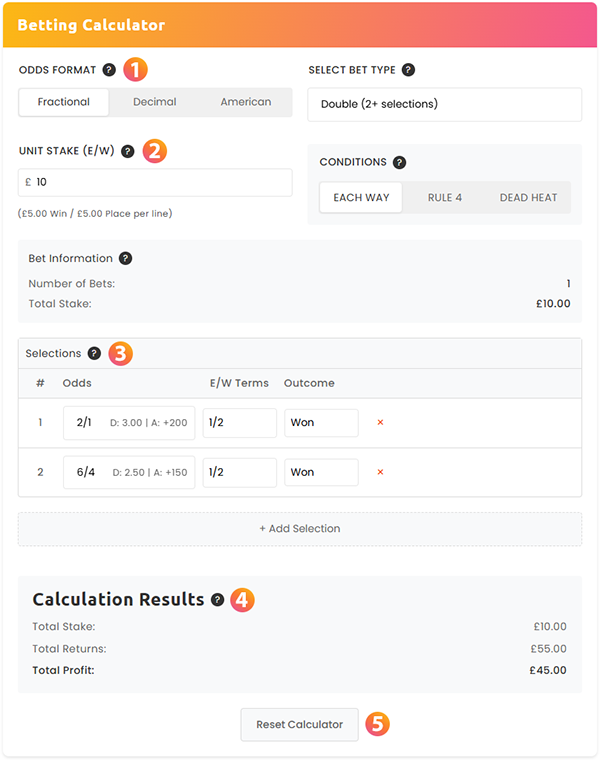
Every bet type on the calculator
Want to do more with our calculator? Here’s a brief description of every bet type on our calculator, how each type functions and when it’s most appropriate to use each:
Single (1 selection)
A stake is placed on a single selection, which is a defined outcome at an event. A profit is received if the stake, along with the defined odds, wins.
Double (2 selections)
A double bet consists of two selections being linked in one bet. The payout is received if both bets win. Stakes accumulate and win from the first bet into the second bet, increasing the total return.
Treble (3 selections)
All 3 selections must win. Each win rolls into the next, so the payout grows at every stage.
Accumulator (4–20 selections)
All legs must win to achieve any payout. Four or more picks can be combined. Accumulators can be made with 4 up to 20 selections. Payouts increase significantly, but risk rises with each additional selection.
Trixie (3 selections)
In total, there are 4 bets placed: 3 bets are doubles and 1 bet is a treble. A minimum of 2 winners are required to return a payout.
Patent (3 selections)
A total of 7 bets are placed, which are 3 singles, 3 doubles and 1 treble. Even if only a single selection wins, there is still a return.
Yankee (4 selections)
A total of 11 bets placed. The bets comprise 6 double bets, 4 treble bets and 1 fourfold. With only two winners, returns are unlocked; with 3 and 4 winners, profits are significantly increased.
Canadian (5 selections)
26 bets: two with doubles and four more are two with four fold bet types, adding up to ten of each. One five fold bet was also placed. At least two winners have to come through to earn a payout.
Heinz (6 selections)
57 bets consisting of doubles (15), trebles (20), fourfolds (15), fivefolds (6), and a sixfold accumulator (1). The minimum required is three winners, and if more are achieved, the payout significantly rises.
Super Heinz (7 selections)
120 bets made for all combinations of doubles (21), trebles (35), fourfolds (35), fivefolds (21), sixfolds (7), a sevenfold accumulator (1). A minimum of 2 winners are needed for a double to land and to receive any payout.
Goliath (8 selections)
247 bets which cover every possible double (28 bets), treble (56), fourfold (70), fivefold (56), sixfold (28), sevenfold (8) and the eightfold accumulator (1). If you want to collect anything, at least 2 winners need to come in for a double.
Choose the one that best meets your goals and bankroll, enter the values in your slip and limits box for target profits. Always play within your means and enjoy the game.
Understanding the odds
Before you stake cash, it pays to know how odds translate into real chances—and where you might find value. Here’s what you need to keep in mind.
Implied odds
Bookmakers embed a built in profit margin by tweaking true probabilities. Implied odds turn the prices you see into a percentage chance. If a team sits at 2.50 in decimal (3/2 in fractions), the implied probability is 1 ÷ 2.50 = 40 percent. Add up the implied chances across all outcomes, and you’ll get more than 100 percent, that extra slice is the bookmaker’s margin.
True odds
This is your own read on the likelihood of an outcome. Maybe you’ve crunched stats, checked injury news and factored in home advantage, and you decide that same team really has a 40 percent shot. If your true odds match or exceed the implied odds, you’ve spotted a potential value bet. True odds aren’t carved in stone, they reflect your research and gut feel. Predictive models can help you narrow the gap, but always trust the data points you’ve gathered.
Finding value
Compare your true odds to what the market implies.
If your probability is higher, you’re looking at positive expected value.
The calculator on this page does the heavy lifting: plug in your stake and odds to see profit, total return and implied probability in one go.
Decimal odds made easy
Decimal odds show how much you get back for every £1 you risk. A 1.61 price means a £1 bet returns £1.61 (that’s £0.61 profit plus your stake). They beat fractions for speed, multiply your stake by the decimal to see total return. Converting to probability is just 1 ÷ decimal. No more head scratching over 4/7 versus 8/13 decimal does the work.
Bet calculator FAQs
What is a betting (or odds) calculator and how does it work?
It’s a simple tool that allows you to enter your stake and odds in any format. It converts between American, Decimal and Fractional, then instantly shows your profit and total return.
What’s the difference between single bet and multi bet (e.g. Trixie, Yankee) calculators?
A single bet calculator handles one outcome. Multi bet calculators break down every combination in structured bets, showing how each winning leg affects your overall return.
How do I calculate my potential winnings and total return?
After entering your stake and the odds of your selections, click “Calculate Results” to see your total returns and profit.
What’s the implied probability and how is it calculated?
Implied probability converts odds into a percentage chance. For example, fractional odds of 4 / 1 (decimal 5.00, American +400) give:
Implied Probability = 1 ÷ 5.00 × 100 = 20%
That 20 percent reflects the bookmaker’s view on the likelihood of that outcome.